Tayrona National Natural Park

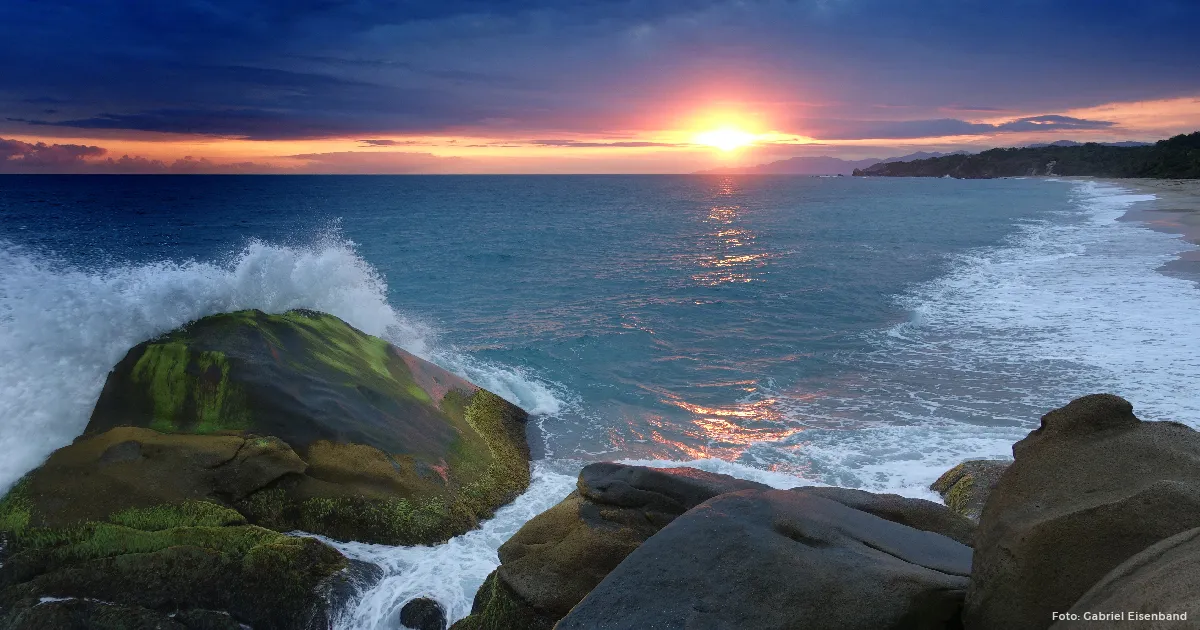
Sunset over the sea with waves crashing on mossy rocks

Located on the Colombian Caribbean coast, it protects the best-preserved tropical dry forest in the country, along with a unique cloud forest that grows below 1,000 meters in altitude, just a few kilometers from a sea of blue waters and coral reefs. Within a relatively narrow strip, coral formations, seagrass meadows, beaches, mangroves, coastal lagoons, and jungle-covered hills converge.

This ecological richness makes Tayrona a vibrant and diverse territory, emblematic of the Colombian Caribbean, with numerous ecotourism options. Here, visitors can enjoy the beach, hike through dry forests, camp, swim in marine pools, snorkel among coral reefs, and observe birds and mammals.
Ancestral territory

Tayrona National Park is part of the Black Line, the ancestral territory of the Kogui, Wiwa, Arhuaco, and Kankuamo peoples of the Sierra Nevada de Santa Marta. The park’s hills, beaches, waters, and forests are home to sacred sites, and each site is connected to others, both physically and spiritually.

Here, immense biological and cultural richness coexist. Its management plan was jointly developed by the four indigenous communities and the National Natural Parks, as a guide for caring for the territory based on ancestral knowledge.

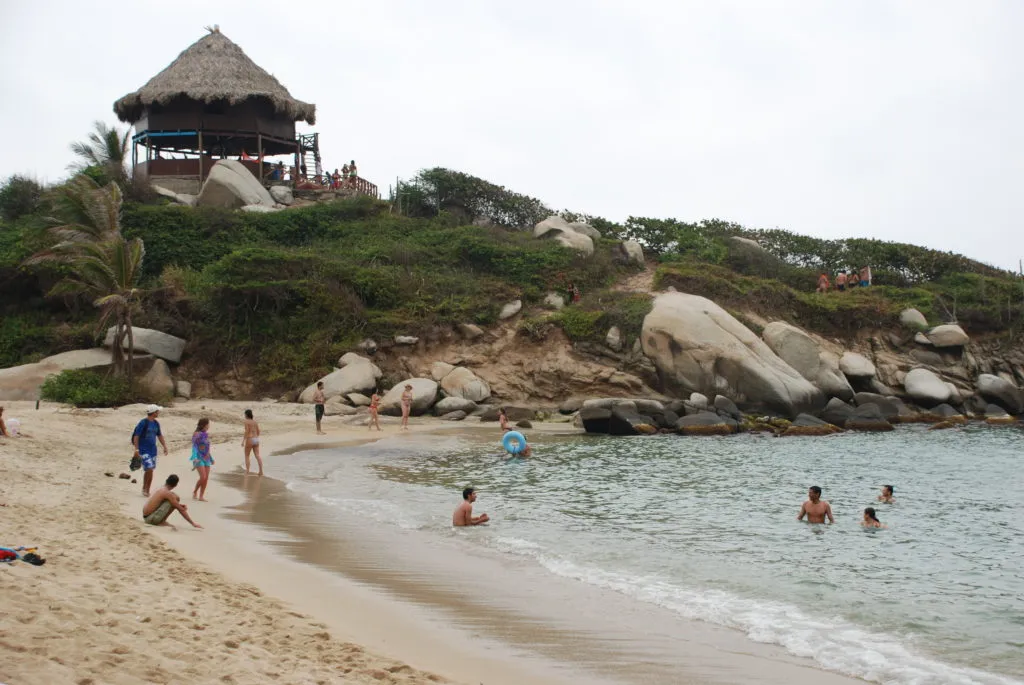
People bathing on a beach next to a thatched lookout on the rocks

Ecosystems

In a continental strip of only 12,692.2 hectares, the Park boasts a remarkable diversity of landscapes with rapid changes in vegetation. Thorny scrubland, dry forest, humid forest, and, in the higher elevations, cloud forest converge there.

The coastal strip includes beaches, coastal lagoons, mangrove forests, and rocky shores. The marine area features coral formations, sedimentary seabeds, seagrass meadows, and algae blooms.

The protected area also safeguards one of the best-preserved tropical dry forest refuges in the country.

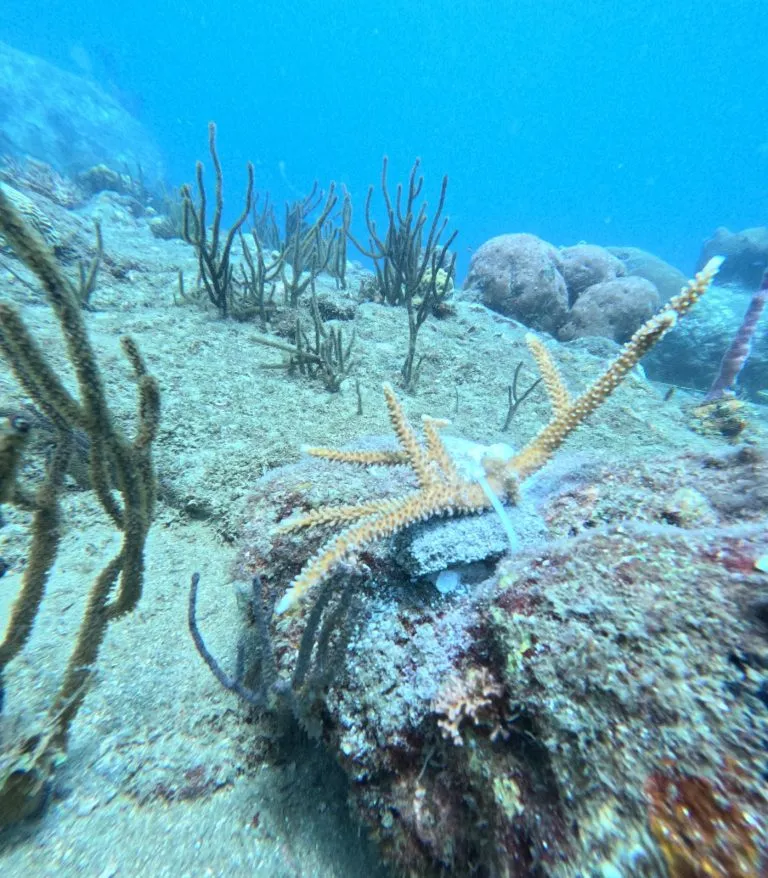
Starfish on a coral reef under clear blue water

Fauna

Mammals: Tayrona National Park is home to 26 species of medium and large mammals. Six of the seven felines found in Latin America live here: jaguar, puma, ocelot, margay, jaguarundi, and margay. Four primate species also inhabit the park, including the howler monkey and the tamarin, emblematic of the area.

Birds: Nearly 400 species have been recorded. The blue-billed curassow (Crax alberti), endemic to northern Colombia, is particularly noteworthy.

Amphibians and reptiles: The diversity of forests, mangroves and coastal areas sustains the life of frogs, snakes, iguanas, sea turtles and the American crocodile (Crocodylus acutus), indicators of environmental health and vital for ecological balance.

Corals and Fish: The coral formations cover approximately 9 km² and are home to 53 species of coral, including the elkhorn coral (Acropora palmata). Around 180 species of fish have been recorded in its waters, including groupers, snappers, parrotfish, and sharks, as well as species endemic to the Colombian Caribbean.

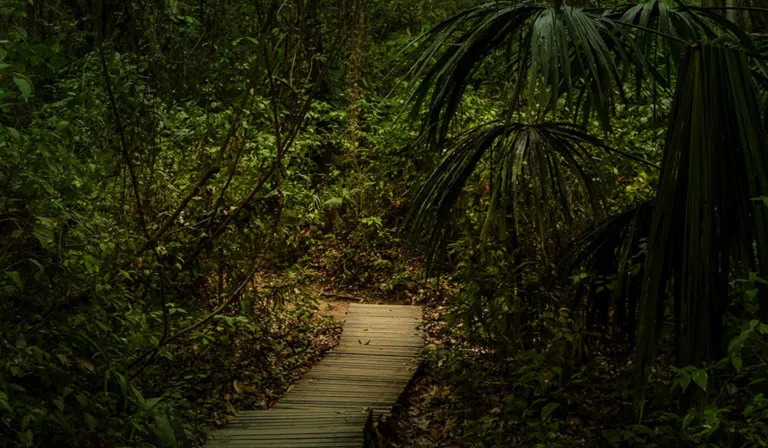
Wooden boardwalk through a dense dry forest

Flora

Bosque seco tropical

Tayrona protects one of the most threatened ecosystems in the country. It comprises 3,167 hectares of tropical dry forest, equivalent to 0.72% of all dry forest in Colombia. It is a forest that loses its leaves or turns green again depending on the time of year, and is home to numerous plant species.

  • Guarumo (Cecropia peltata)
  • Western coffee (Senna occidentalis)
  • White Majagua (Heliocarpus americanus)
  • Guaimaro (Brosimum sp.)
  • Tachuelo (Zanthoxylum sp.)
  • Fig tree (Ficus nymphaeifolia)
  • Balso (Ochroma pyramidale)

There is also avocado, bay leaf, red guava or cordoncillo.

Mangroves

They are the guardians of the coast. They protect the soil, act as a barrier against tides, and are the cradle of countless marine and coastal species. They also help combat climate change by storing large amounts of carbon.

In Tayrona National Park, they are located in the bays of Concha, Chengue, Cinto, and Neguanje. These amphibious forests, adapted to living between the sea and the land, are made up of four species of mangrove:

  • Red mangrove (Rhizophora mangle)
  • Black mangrove (Avicennia germinans)
  • White mangrove (Laguncularia racemosa)
  • Mangle zaragoza (Conocarpus erectus)
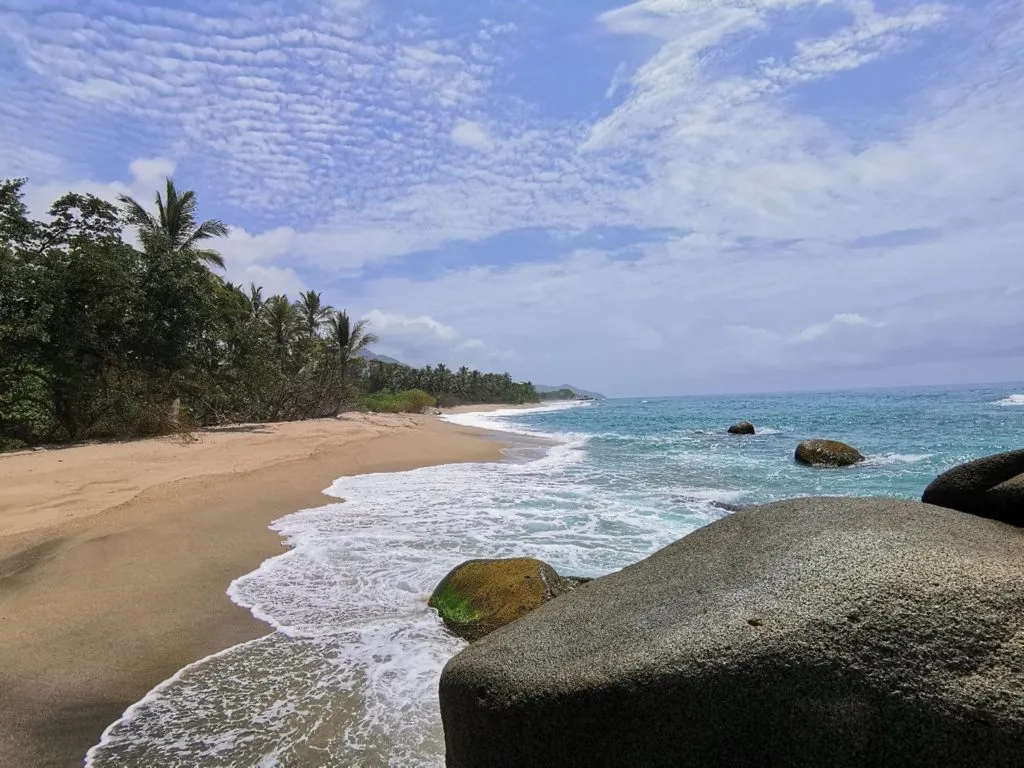
Golden sand beach with palm trees and large boulders

Conservation Objectives

An ancestral and collective commitment

The management of Tayrona National Park stems from an agreement between the indigenous communities of the Sierra Nevada de Santa Marta and Colombia’s National Natural Parks. Together, they developed a management plan that also incorporates input from local communities and guides the protection of the territory based on ancestral land-use planning.

This plan integrates the management of Tayrona and the Sierra Nevada de Santa Marta National Natural Park. Both territories are connected by biological and cultural relationships, and by the sacred sites that are part of the Black Line.

Here, conservation encompasses water, forests, the sea, and the ecological, cultural, and spiritual connections that sustain life in the region.

Continue